Repair Services
Denver Artificial Turf Repair: Local Fixes for Worn Surfaces
When turf starts lifting, flattening, or shedding infill, Denver owners need repairs that match the surface and the season. Here’s how local pros handle it.
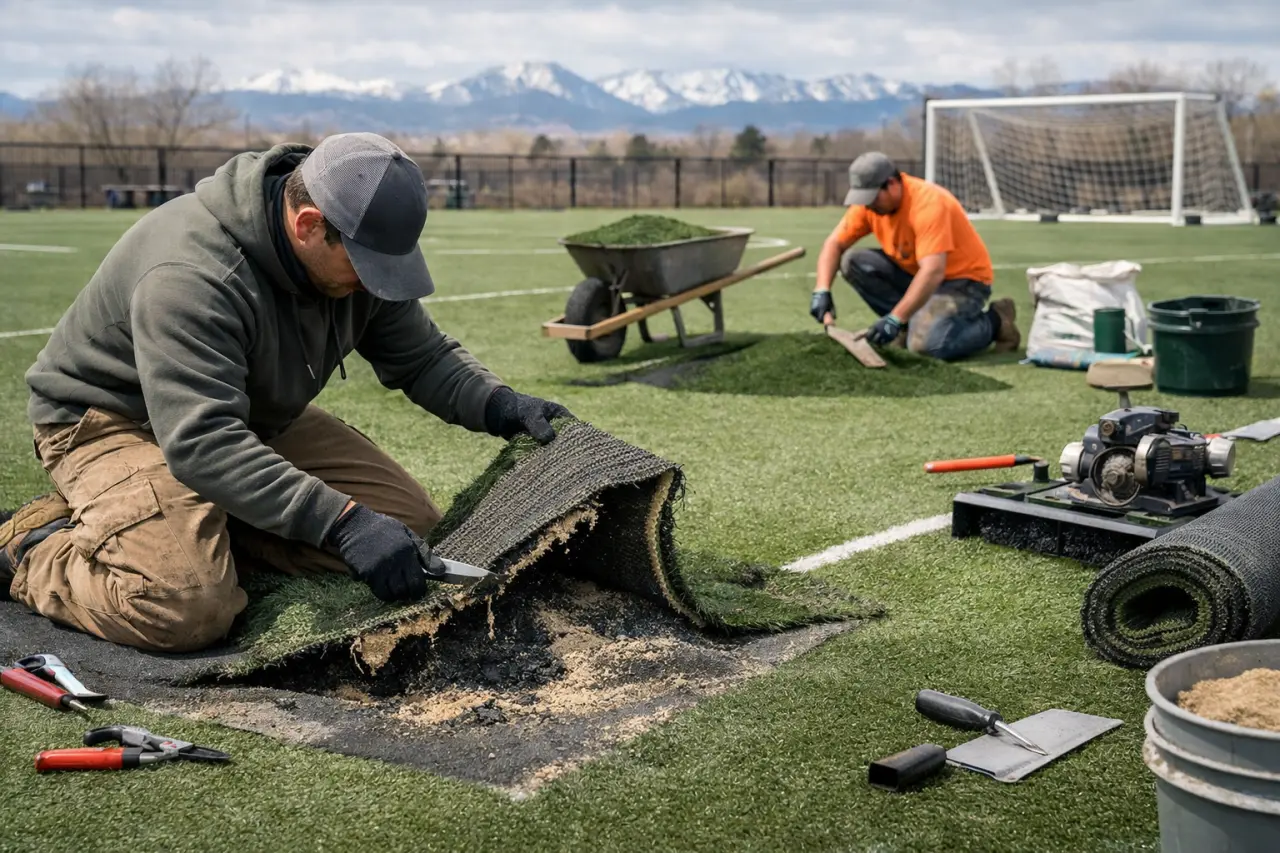
Denver turf repairs are usually about the surface, not the whole yard
In Denver, artificial turf usually holds up well until the small problems start stacking up: a seam that opens, a pet run that mats down, or infill that has thinned out after years of foot traffic. The good news is that a lot of the common issues can be repaired without replacing the whole surface. The Synthetic Turf Council notes that routine maintenance, grooming, and infill replenishment are central to keeping synthetic turf performing well over time, and its glossary specifically flags seam repair as part of normal care (Synthetic Turf Council; Synthetic Turf Council).
That matters here because Denver weather puts turf through big temperature swings. Heat can soften the surface, winter can make edges feel stiff, and repeated freeze-thaw cycles can expose weak spots that were already starting to fail. The repair job is often less about cosmetic touch-up and more about restoring the way the surface lies, drains, and cushions under use.
What Denver homeowners usually ask repair crews to fix
The most useful repair services are the ones that can diagnose the problem instead of jumping straight to replacement. Around Denver, the most common service calls tend to fall into a few buckets:
- Seam repair: when two turf panels separate or curl at the join
- Patching: for burns, tears, pet damage, or isolated wear spots
- Infill replacement or redistribution: when the fibers are supported unevenly or the surface feels hard
- Fiber grooming and restoration: to lift flattened blades and improve appearance
- Odor and cleaning work: especially where pets use the turf heavily
The industry guidance is pretty consistent: a regular maintenance program should include surface cleaning, debris removal, grooming, infill redistribution, and decompaction, and loose or opening seams may need prompt temporary adhesive until a proper repair is made (Synthetic Turf Council; Synthetic Turf Council). For Denver owners, that means the right contractor should talk first about the damage pattern, not just sell a new install.
Denver companies that point toward repair-minded service
Some Denver-area turf businesses focus on installation, but their service pages still give a strong clue about who is set up for maintenance and restoration work.
Turf Revival Pros says it handles turf cleaning and restoration in Denver, including infill redistribution, fiber brushing, seam inspection, and putting green refresh work (Turf Revival Pros). That combination makes it a useful fit for surfaces that have gone dull, compacted, or uneven but do not need a full rebuild.
303 Turf Cleaning markets artificial grass and turf cleaning in Denver and positions itself around routine care for synthetic lawns (303 Turf Cleaning). For owners whose main issue is a tired-looking surface, this is the kind of provider that may be better aligned with maintenance-first work than a full replacement crew.
Turf Colorado LLC says it creates and services yard designs in the Denver metro area and also offers maintenance (Turf Colorado LLC). That broader landscape background can matter when a turf repair job also involves grading, edging, or the transition between synthetic turf and surrounding hardscape.
Frontier Turf serves the Denver Metro and Front Range with artificial turf installation and landscape work, and it emphasizes workmanship warranties (Frontier Turf). When a repair problem seems tied to how the surface was originally installed, that kind of installer-backed service can be relevant.
How to tell whether repair is enough
Not every damaged turf surface needs replacement. In many cases, a repair is the better move when:
- the damage is localized to one area
- the backing is still intact across most of the surface
- seams are separating, but the field or lawn is otherwise stable
- infill loss or compaction is the main issue
- fibers are flattened rather than actually missing
Replacement starts making more sense when multiple areas have failed, drainage is compromised, or the surface has become so brittle that patches will not hold.
The Synthetic Turf Council’s maintenance materials also make clear that if a field or surface is no longer performing in the desired range despite targeted maintenance, replacement may be the next step (Synthetic Turf Council). For a Denver property owner, that’s a practical standard: if repairs keep exposing new problems every few months, the surface may be beyond spot fixes.
What to ask before you hire in Denver
A good repair conversation should sound specific. Ask whether the company handles:
- seam inspection and re-bonding
- patching that matches the pile height and color
- infill top-off or redistribution
- odor cleanup for pet turf
- brushing or grooming after repair
- work on putting greens, pet areas, or landscape turf
It also helps to ask how they decide between a cosmetic fix and a structural one. The best local crews usually inspect the subbase, check the backing, and look for drainage or edge movement before they talk about patch material.
The bottom line for Denver turf owners
If your turf is lifting, flattening, or losing infill, the first step is usually a repair assessment, not a replacement quote. Denver has companies that lean into cleaning, restoration, and maintenance, and that is often the right lane for a surface that still has life left in it. Turf Revival Pros, 303 Turf Cleaning, Turf Colorado LLC, and Frontier Turf each reflect that maintenance-minded side of the market in different ways (Turf Revival Pros; 303 Turf Cleaning; Turf Colorado LLC; Frontier Turf).
For most Denver properties, the smartest repair is the one that fixes the seam, restores the infill, and gets the surface back to feeling even underfoot.
Related articles
Lakewood Artificial Turf Repair: Choosing the Right Fix
When turf starts to seam, flatten, or separate, Lakewood owners can narrow the fix fast by matching the repair to the damage.
Editorial Team
Lakewood Artificial Turf Repair: How Local Fixes Hold Up
Small turf problems can spread fast in Lakewood’s changing weather. Here’s how to spot repair needs and compare local pros before damage grows.
Editorial Team
Fort Collins Artificial Turf Repair: What to Fix Before It Spreads
Fort Collins turf repairs often start with seams, thinning infill, or a lifted edge. Here’s how local providers handle the fixes that keep surfaces usable.
Editorial Team